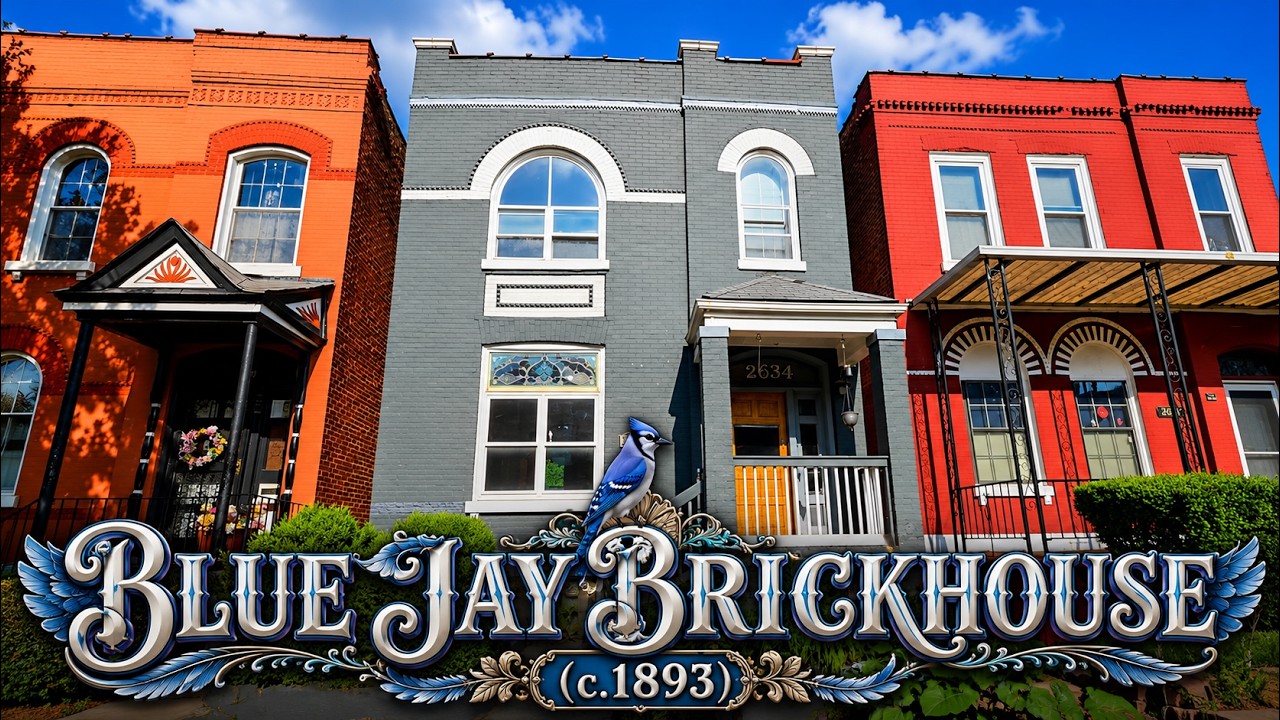
Listings show you photographs. Home tours can show you scale, layout, architectural details and how the spaces actually connect.
Explore Fox Park home tours below. Follow the rooms, architectural details and layouts of homes featured in the neighborhood.
Want to explore more of Greater St Louis? Our Community Home Tours collection brings together video walkthroughs from neighborhoods and communities throughout the region, making it easy to explore homes, architecture, layouts and local character.
Welcome to Fox Park, a south St. Louis neighborhood with its namesake public park set among the residential blocks. The City defines its modern outline by Interstate 44 on the north, Nebraska Avenue on the west, South Jefferson on the east and diagonal Gravois on the south. The detailed map shows the park between Ohio and California avenues.[1][2]
A useful introduction is the Fox Park Neighborhood Association, which welcomes people to its meetings and connects neighbors with volunteer projects, events and community information. Its website brings the calendar, meeting materials and ways to participate together, offering a starting point for getting involved whether you have just arrived or already know the neighborhood.[3]
Start with the neighborhood boundaries. General boundaries: I-44 · South Jefferson Avenue · Gravois Avenue · Nebraska Avenue. See the linked City map for the detailed outline.
Enlarge imageMansard-roof rowhouses in Fox ParkMansard-roof rowhouses in Fox Park, photographed December 27, 2011.[4]Paul Sableman · CC BY 2.0Full image: 4,608 × 3,456 pixels
The illustrated community guide
Explore Fox Park
Lumber, skilled trades and the Fox name
Neighborhoods · Work & Place
Lumber, skilled trades and the Fox name
Fox Park’s industrial history can be followed through an address before it is followed through a landmark. The Missouri Historical Society’s index to E. D. Kargau’s 1902 commercial survey places Fox Brothers Manufacturing at Ohio and Sidney, while also recording a location at Kosciusko and Trudeau. The entry connects the familiar neighborhood name with an enterprise operating across the city. The entry provides a dated reference for comparing business records with the surviving buildings.[5]
The history maintained by Glaziers Local 513 supplies another perspective on that industry. It names Fox Brothers among the sash-and-door businesses where glaziers worked in the late nineteenth century. These trades joined glass, wood and skilled handwork: workers cut panes and secured them into windows produced by mills and suppliers. The union dates its original charter to October 4, 1899, before a later change of local number. Reading this account alongside the company record connects the neighborhood’s decorative windows with the workers and manufacturers who produced them.[6]
The park itself preserves the Fox connection. The City records recreational use beginning in 1917 under a permit from Fox Brothers, followed by purchase in 1931.[7]
Neighborhoods · Preservation
How Fox Park’s preservation boundaries developed
Fox Park’s preservation history involves several designations with different meanings. Missouri’s State Historic Preservation Office identifies Fox Park as a certified local historic district, with certification dated July 1, 1985. The state explains that certified local districts have been evaluated as substantially meeting National Register criteria. The 1985 milestone marks local-district certification within this preservation framework.[8]
DeSales Community Development’s neighborhood history describes the organizing behind the maps. The neighborhood association sought to extend preservation recognition into northern Fox Park in the early 1980s. In 2003, the Fox Park portion was separated and renamed with standards responding to its own architecture. Organizing for the southern extension began in 2009 and culminated in 2011. This sequence shows residents connecting architectural protection and reinvestment through years of neighborhood organizing.[9]
Ordinance 68833 extended the local district toward Gravois and applied the existing standards to the added area. Its legal description follows street centerlines and alley lines, including Nebraska, Jefferson and California. Those precise lines matter when researching an individual property. A neighborhood name, a broad tourist description and a district’s legal boundary answer different questions; the ordinance provides the authoritative parcel-level starting point for the local designation.[10]
The National Park Service separately records the St. Francis de Sales Historic District, listed on November 28, 2012, under number 12000979. Its location is described through Nebraska, Jefferson, Victor, Gravois and Pestalozzi. This is a distinct National Register designation associated with the southern part of Fox Park, rather than a new name for every block in the modern neighborhood.[11]
Neighborhood participation
Meetings, membership and ways to help
The Fox Park Neighborhood Association lists its general meetings at Jefferson Avenue Mission, 2241 South Jefferson, with a Zoom option for remote participation. Its calendar carries meeting details, and the website links meeting materials and resources. Those links provide a way to follow an issue before attending or to catch up on an earlier discussion.[3]
Participation extends beyond property owners. The association’s membership page includes resident renters, homeowners and businesses, as well as a nonvoting Friends of Fox Park category. It also explicitly welcomes people who are not members to meetings, conversations, committees and planning. Membership supports park and green-space care, neighborhood events and charitable projects for schools and clubs.[12]
The board, committees and events are staffed by volunteers. The association describes regular roles, occasional help for a particular event and partnerships with businesses or other organizations. That range allows residents to contribute through an ongoing committee or a smaller project. Its volunteer page supplies the contact route for proposing an idea or asking where help is needed.[13]
Community programs
Youth recreation and practical support
DeSales documents its Redbird Rookies league at the Fox Park Softball Field. Part of the Cardinals Care program, it offers noncompetitive baseball and softball for children, with the broader program described for ages five through thirteen. DeSales’s current community-resources publication also describes off-field educational and cultural experiences alongside the games, connecting recreation with other opportunities for participating children.[14]
The league’s registration information explains that uniforms and equipment are supplied and that a parent or guardian must complete the required registration. Enrollment is organized by season; the completed 2026 league page is closed to registration. Its organizer contact is useful for asking about the next season’s eligibility, capacity and application process without treating an old registration page as an available place.[15]
DeSales’s Community Services Coordination team helps people connect with rent and utility assistance, food resources, education and employment services. Fox Grove Management residents receive priority; other families in the organization’s service area may be assisted as capacity allows. An interest form provides the initial contact. This is a referral and coordination resource, with participation determined by the program’s stated scope and capacity.[16]
City services
Collection information and request follow-up
The City’s refuse lookup begins with an exact address and supplies collection information for trash, yard waste, recycling and bulk items. This is useful in a neighborhood where the applicable arrangement belongs to the property and block. It also keeps collection information separate from a general neighborhood calendar, especially when holiday or service notices change the normal pattern.[17]
The City’s recycling guidance distinguishes alley collection from individual roll carts. Alley recycling ended in 2025, while residential roll-cart recycling continues; the City provides drop-off alternatives for residents who need them. A dumpster behind a property should therefore not be assumed to provide the same recycling service as a household roll cart. The official page explains the available arrangements.[18]
For nonemergency municipal issues, the Citizens Service Bureau accepts requests online and at 314-622-4800. Status can be checked by request number or address, providing a record for follow-up. The City’s separate Neighborhood Improvement Specialist finder uses an address or parcel to identify the assigned specialist and other contacts when a matter needs neighborhood-level coordination.[19][20]
The namesake park
Courts, play areas and dog-park access
The City’s Fox Park inventory lists 2.69 acres with a basketball court, softball field, playground and dog park. These are separate facilities within a compact neighborhood park, so a ball game, playground visit and trip with a dog involve different parts of the space. The City record links individual amenities and identifies the Parks Division as the maintaining department.[21]
The neighborhood association gives the park address as 2716 Shenandoah Avenue and also describes picnic areas, a field house and a pavilion for events permitted through the Parks Department. Its Park and Beautification Committee assists with care of the park and invites volunteers to participate in park planning. That committee is a direct connection for residents interested in helping maintain the shared space.[22]
The dog park sits between the ball field and the playground/splash-pad area, with its entrance on the Shenandoah side. Access is through a locked gate, and dog-park members receive the code. The association publishes membership information, a user guide and a waiver requirement for adult handlers, including a pet sitter accompanying a member’s dog. These arrangements differ from simply entering the surrounding park.[23]
Gardens & growing
Shared beds and a neighborhood teaching farm
The DeSales Community Garden occupies part of the 2600 block of California Avenue. DeSales describes individual garden beds, shared beds, a patio with picnic tables and a Missouri native-plant garden. Membership involves helping maintain the shared space, and its page provides an interest form for people who would like to join. Shared planting includes food crops and flowers, giving members work beyond their individual beds.[24]
Urban Harvest STL’s farm at Rung for Women is another Fox Park growing space. The operator describes raised beds, in-ground rows, a greenhouse, a food forest and keyhole beds. Produce is provided to Rung members through a members’ market, while gardening and sustainability workshops are offered to members and the general public. The public learning opportunities and member food distribution serve different purposes.[25]
Seed St. Louis, which supports the DeSales garden, publishes classes on gardening, fruit trees and community food projects. Its schedule explains registration and links recordings of past sessions. These regional resources can complement work in a neighborhood garden, including learning how to organize a shared project or grow food in a small space.[24][26]
Architecture · Houses & Streets
Reading the variety within a brick streetscape
Fox Park’s varied residential character developed over several decades of construction. The City’s historical chapter emphasizes development between the 1880s and the early twentieth century, with houses and flats reflecting Italianate and mansard forms, revival styles, Arts and Crafts influences and simpler twentieth-century designs. Small corner stores added another building type to the residential blocks. Their presence helps explain a streetscape where domestic entrances, shopfronts and different roof profiles can appear within a short walk, while brick and repeated window proportions provide continuity.[27]
The Cultural Resources Office’s district description emphasizes buildings designed for several households as well as single-family houses. A two-story façade therefore does not, by itself, reveal an original floor plan or number of homes. Entrances, stairs and the arrangement of windows deserve as much attention as ornament. The district’s combination of Italianate, Second Empire and later revival details also cautions against assigning one stylistic label to every red-brick building. The useful comparison is between individual façades and their neighbors: what repeats, what changes, and how those choices shape the street.[28]
The district standards give precise names to some of those details. Cornices may combine brick, wood or sheet metal; dormers bring windows through sloping roofs or mansards. The standards also distinguish alley houses from carriage houses, reminding readers to look beyond the front elevation. Rear buildings can preserve another part of a lot’s history, including residential use along the alley. These definitions help turn a general impression of an old neighborhood into observations about rooflines, materials, entrances and the relationship between front and rear buildings.[29]
Architecture · St. Francis De Sales
A Gothic church shaped by rebuilding
St. Francis de Sales began as a parish in 1867, before the present church existed. Its first church was dedicated on May 24, 1868, and was destroyed in the tornado of 1896. The eventual replacement was dedicated on November 26, 1908. This sequence explains why the parish’s history begins decades earlier than the imposing building at Ohio and Lynch.[31]
The 1978 National Register nomination describes a design that changed substantially before construction. St. Louis architects Klutho and Ranft revised an earlier German scheme, removing subsidiary towers and substituting brick for the proposed cut-stone exterior. Inside, the hall-church arrangement gives the side aisles unusually high vaults, creating a broad, connected interior rather than sharply separating a tall center from low side passages. The nomination also records carved figures holding tools beneath the choir, including a bricklayer’s mallet and chisel. Such details connect monumental architecture with the crafts that made it. The record discusses several possible German precedents for the design.[32]
The institution’s preservation account identifies July 2005 as another turning point, when St. Francis de Sales became an oratory under the Institute of Christ the King Sovereign Priest. Its account links renewed religious use with the repair of the church and associated buildings. That transition belongs to the building’s continuing history: preservation here has involved finding sustained use for a large inherited campus as well as conserving its architectural fabric.[33]
Enlarge imageSaint Francis de Sales Oratory naveThe nave of Saint Francis de Sales Oratory with Good Friday decoration, photographed April 14, 2017.[30]Nheyob · CC BY-SA 4.0Full image: 4,776 × 3,961 pixelsArchitecture · Industry & Reuse
Factories, new uses and a neighborhood’s working fabric
The Koken Barbers’ Supply nomination describes industrial growth assembled in stages. A factory dating to 1892 expanded along Ohio between 1899 and 1905. In 1912 the company added a five-story reinforced-concrete plant at 2528 Texas, on land previously used for its lumber yards. The new building included offices and showrooms on the second floor as well as manufacturing space. This history helps explain the contrast between substantial factory blocks and surrounding houses. Production, administration and the display of finished goods could occupy the same enterprise, while additions gradually changed its footprint. The nomination documents the complex’s historical development.[35]
The former Fox Brothers building offers a documented example of adaptive reuse. CannonDesign’s project account describes restoration of the historic warehouse for Rung for Women, followed by additions. The work included matching older mortar characteristics and designing replacement windows to follow historic profiles. New brickwork used contemporary detailing while responding to the existing building. The result illustrates a practical architectural question: how can an inherited industrial structure retain recognizable materials and proportions while supporting a different use? The project record addresses that physical transformation without requiring every new element to imitate the old building.[36]
Reinvestment has also depended on organizations working across many smaller properties. DeSales Community Development traces its founding to 1976 as DeSales Community Housing Corporation, supporting Fox Park and Tower Grove East. Its early work combined neighborhood organizing with rehabilitation, followed in the 1990s by a larger role in housing development and long-term ownership. That history broadens the preservation story beyond a prominent church or factory. Keeping a residential neighborhood in use also involves the repeated work of managing buildings, repairing homes and maintaining institutions capable of staying involved over time.[37]
Enlarge imageKoken Barbers’ Supply factory exteriorA factory exterior in the Koken Barbers’ Supply Co. Historic District, photographed September 8, 2012.[34]Parker Botanical · CC BY-SA 3.0Full image: 3,814 × 1,943 pixelsEducation · Campus History
Classrooms, a theater and school memories
Education developed alongside the parish. St. Francis de Sales opened an elementary school in 1869 and added a junior high school in 1939. The latter developed into a high school whose first class graduated in 1947. The elementary school was consolidated with other schools in 1973, and the high school closed in 1974. These dates trace the former parish programs associated with the surviving campus.[31]
An October 2008 Washington University report documents a less obvious educational space: an approximately 8,000-square-foot children’s theater within the former girls’ school, built in 1888. Architecture students prepared renovation proposals for the space, bringing the building’s educational past into a new design exercise. A school campus was therefore more than a collection of classrooms. It could contain performance, assembly and social spaces whose original purpose became difficult to see after alterations. The university’s report preserves these renovation proposals and the condition documented in 2008.[38]
The St. Louis County Library’s yearbook catalog offers a different way into the school’s history. It lists a 1955 St. Francis De Sales High School volume titled Spire. A dated yearbook gives an alumni researcher a specific object to request, instead of relying only on a building photograph or institutional timeline. The catalog supplies the publication’s identity, while the volume itself offers the next step for researching its students, clubs and events.[39]
Schools & enrollment
The Shenandoah campus and application routes
Momentum Academy–Fox Park is a kindergarten-through-eighth-grade campus at 2617 Shenandoah Avenue. The operator lists 314-450-7651 for the school, and Missouri DESE confirms the campus under Momentum’s current name; the organization was formerly known as EAGLE. Families will therefore encounter the newer name in current school contacts and application materials.[40][41]
Momentum directs applications through SchoolAppSTL and offers an admissions-interest form for questions before applying. Its own information distinguishes the Fox Park K–8 campus from its preschool program at Tower Grove South. Choosing a school organization is therefore only part of the process: the requested campus and grade also need to match the program offered.[42]
SchoolAppSTL separates submitting an application from receiving a place. When a participating school has more applicants than available seats, a lottery determines offers and waiting-list order; an accepted offer must then be followed by enrollment with the school. A nearby address does not replace these steps or guarantee a seat at Momentum.[43]
For district school assignments, the City provides a separate address-or-parcel search for elementary, middle and high schools. Families can use the exact home address and then confirm the result with SLPS for the relevant grade and entry year. The neighborhood name alone is not an attendance assignment.[44]
Library & learning
Books, computers and making at nearby Barr
Barr Library is at 1701 South Jefferson, beyond Fox Park’s northern boundary. The branch lists reservable computers and printing, Wi-Fi, meeting rooms, bicycle racks and a book drop. Its page also brings together branch information and event listings. This is a nearby library resource along the Jefferson corridor, rather than a facility located inside the Fox Park neighborhood.[45]
Barr’s lower level houses a Creative Experience digital makerspace. St. Louis Public Library describes these spaces as free for all ages with an SLPL card, and publishes equipment information and a program calendar. Central and Julia Davis also have Creative Experience spaces, so location-specific listings matter when choosing a workshop or identifying where a particular tool is available.[46]
The library’s circulation policy explains eligibility and documentation. Adult City residents can obtain full borrowing privileges with identification and proof of current address; the policy also describes limited privileges for people without the full documentation. Requirements for children include a parent or guardian process. These provisions offer several ways to establish borrowing access, rather than relying on an assumption about which documents are necessary.[47]
Food & local businesses
Three food addresses and a neighborhood directory
Little Fox is at 2800 Shenandoah Avenue near the park. The restaurant offers indoor and patio dining as well as carryout, and publishes menus for different services. Its seasonal selection spans vegetable dishes, fish, meat and desserts, with a separate drinks offering. The operator’s menu and reservation links provide the current choices without relying on an older review’s list of dishes.[48][49]
Lona’s Lil Eats gives its Fox Park address as 2199 California Avenue, at the Accomac corner. Rice-paper wraps are a central part of its menu, which describes both plant-based and meat choices and a range of sauces. The restaurant maintains separate Fox Park and Kirkwood ordering links, so the city location can be selected explicitly when arranging take-away.[50][51]
Coffeestamp lists 2511 South Jefferson as its local address. The coffee roaster’s website offers retail coffee and subscriptions, describes its interest in different origins and small lots, and links brewing resources. It therefore provides both a neighborhood coffee address and a way to explore beans for brewing at home.[52]
For a wider view, the neighborhood association’s Shop, Source, Serve Local page maps businesses, churches and other organizations. It also gives a contact for adding an omitted organization, making the directory a useful complement to individual operators’ websites.[53]
Getting around
Bus connections and bringing a bicycle
MetroBus 10, Gravois-Lindell, includes Jefferson and Gravois among its published major stops. Its route connects this south-city junction with Civic Center and Central West End transit centers, with other listed stops along Gravois and Lindell. The route page provides the map, direction-specific timetables and service alerts together, allowing the same connection to be checked for different travel days.[54]
MetroBus 11, Chippewa, lists Jefferson and Russell along Fox Park’s eastern edge. Its major stops include Civic Center, Broadway and Chippewa, Grand and Chippewa, and Shrewsbury-Lansdowne Transit Center. This provides a second documented route serving the Jefferson corridor. Current maps and service notices are preferable to assuming that a previously used departure or stop pattern remains unchanged.[55]
Metro’s Bike & Ride guidance explains how a bicycle can accompany a transit trip. MetroBus vehicles have two-bike racks, available on a first-come basis, and Metro publishes illustrated loading instructions. Bicycles are also allowed on MetroLink under its boarding and space rules. Combining a bicycle with transit is therefore an option, although rack or train space is not guaranteed.[56]
A closer look · Historic places & their boundaries
Historic places & neighborhood landmarks
These profiles connect the history of Fox Park with particular buildings and the people who used them. The linked designation records identify the specific places and boundaries recognized for their history.
LOCAL DISTRICT & NATIONAL REGISTER CONTEXTDifferent maps, different designationsFox Park and its historic districts
The original Fox Park local ordinance describes a northern area extending from Interstate 44 toward Victor and nearby alleys, between Nebraska and Jefferson. Read that boundary together with the later extension, rather than treating the original northern district as the complete present local district.[57]
McKinley Fox is a separate National Register district east of Jefferson, listed in 1984. Its shared word “Fox” does not make it interchangeable with Fox Park or the St. Francis de Sales district.[58]
INDIVIDUALLY LISTED NATIONAL REGISTER BUILDINGSt. Francis de Sales Church2653 Ohio Avenue
The National Park Service lists St. Francis de Sales Church under its own record, number 78003393, dated November 2, 1978. The listing identifies Klutho and Ranft as architects and recognizes architectural and religious significance. Its Late Gothic Revival designation concerns the church itself. This individual record is useful when distinguishing the landmark building from the much larger St. Francis de Sales Historic District listed in 2012. The two entries document different scales of place: one monumental building and a surrounding urban district.[59][11]
HISTORIC INDUSTRIAL BUILDING · DISTRICT RESOURCEFox Brothers Manufacturing Building2717 Sidney Street
The City’s February 2019 Preservation Board materials identify this building as a 1925 Fox Brothers factory within both the expanded local Fox Park district and the St. Francis de Sales National Register district. The Rung proposal combined rehabilitation with removal of ancillary industrial buildings and a connected one-story addition. The staff report is valuable because it records the actual preservation choices under review—what would remain, what would be removed and how new construction would meet the old. As an agenda document, it records a proposal and recommendation rather than the final decision.[60]
NATIONAL REGISTER INDUSTRIAL DISTRICTKoken Barbers’ Supply complexOhio, Texas, Sidney and Victor
The Koken Barbers’ Supply Co. Historic District was listed on February 7, 2007, under National Register number 07000023. The federal record describes an area bounded by Ohio, Sidney, Victor and the alley east of Texas, recognizing industry and architecture. The district designation encourages a view of the complex as an ensemble rather than an isolated façade. Its different buildings and construction phases belong to the history of one manufacturing operation, even when later uses divide the property into separate addresses.[61]
Community Memory · People and places
The stories a neighborhood carries
The history of Fox Park lives in its streets, working buildings and the efforts of people who cared for them. These stories trace the neighborhood’s changing institutions and the memories carried by its streets.
Community Memory · Workers In The Archive
The people behind the millwork
The State Historical Society of Missouri preserves Carpenters’ District Council records dating from 1892 to 1979. Within that wider regional collection, its finding aid specifically indexes Fox Brothers Manufacturing labor-dispute material in folders 204, 205, 207 and 208. The collection includes contracts, correspondence, minutes and apprenticeship records, opening a route into the working relationships behind the neighborhood’s building trades. This is a different kind of memory from a company advertisement: it preserves evidence of negotiation, organization and training. The catalog does not by itself tell us the outcome of a particular dispute, and the case files have not been reviewed for this guide. It does identify where a fuller account of the workers’ experience can begin.[62]
Community Memory · Anniversaries In Print
A parish repeatedly records its own history
St. Louis County Library’s jubilee-history catalog records several moments when St. Francis de Sales looked back on itself: a fiftieth-anniversary publication for 1867–1917, a seventy-fifth for 1867–1942 and a centennial for 1867–1967. It also lists anniversary publications of the Young Ladies’ and Young Men’s sodalities and issues of the Monthly Messenger. Together, these titles show that community memory was produced repeatedly, by groups within the parish as well as by the institution as a whole. They offer researchers dates, titles and microfilm references with which to pursue those voices. The catalog’s publication and microfilm references make these records available for further research.[63]
Community Memory · An Unfinished Possibility
Design students imagine the theater again
Washington University’s October 2008 account preserves a specific episode of community design work. Fifty-five students began with a site visit and a one-day design session on August 23; selected teams later developed proposals presented on October 17. The winning team, led by Ellen Leuenberger, proposed a courtyard, reworked stairs and flexible theater seating. The article also recalls the space’s earlier use by the Benton Park Drama Club in the 1920s and its conversion into classrooms in the 1940s. The club’s name belongs to its history, while the building stands on the Fox Park campus. The drawings preserve the students’ proposed future for an interior that had already served several different purposes.[64]
Community Memory · A Resident’S Account
Planting shade and recording the work
Writing for the park’s centennial in November 2017, resident Mark Groth described his own involvement in the park committee and credited Beth Stelmach and Christine Ingrassia with helping turn discussions into improvements. His account preserves the practical texture of volunteer work: planning, seeking support, planting trees and revisiting ideas that did not all happen as first imagined. He recalled later seeing people using shade from trees the committee had planted. That small observation gives the story a timescale different from a construction date: an improvement grows into usefulness after the workday ends. Read as a participant’s recollection, the essay adds an individual voice to the public record without making that voice stand for every resident’s experience.[65]
Research sources & image credits
Numbered citations lead to City records, historical research and the organizations responsible for current services. 3 distinct documentary photographs appear once each, with their dates, creators, reuse terms and full-resolution links. Historical plans and photographs describe their own periods. Nearby destinations outside Fox Park are identified in the text. The Grand Gateway and Archway backdrop are decorative brand artwork.
Continue exploring Greater St. Louis beyond Fox Park. Search by community, browse the geographic hierarchy, or use the map to discover neighboring city neighborhoods and communities throughout the metropolitan region.
Greater St. Louis Community Atlas
Use Ctrl + scroll to zoom the mapUse two fingers to move the map
Map Preview Scroll normally here, or use the button below for the interactive map.
Loading Community Atlas Terrain map and metropolitan boundaries are loading.
Use two fingers to move the mapPinch with two fingers to zoom
Terrain/topographic basemap by MapTiler. Metropolitan and county-equivalent boundaries use U.S. Census Bureau TIGERweb geography.
Explore Greater St. Louis
Search a community directly or narrow the alphabetical directory by one of the metropolitan area's component jurisdictions. The map is a discovery tool, not a ranking.
Community Directory · A-Z
↓ More communities below
Atlas Scope Metropolitan AreaGreater St. Louis
Missouri + Illinois metropolitan region
Communities appear alphabetically. Geographic filters organize the directory by location; they are not recommendations or rankings.
Geographic Areas
Choose a state or county to highlight it and filter the community directory. The map position stays where you left it.
The Next Step · Your Property
How Much Is Your Home Worth?
Own a home in Fox Park? Explore your property’s estimated value and consider how recent sales, location, architecture, condition and local market activity may influence its position. When you are ready for a closer look, Christopher can help evaluate comparable sales and your next steps.